Feyikemi's Story of Faith, Hope and Love
Feyikemi Akinnawo
5/15/20267 min read
The Diagnosis
The teenage years arrived like a storm I did not see coming. My body began to change, not in the gentle or predictable ways I had imagined, but in ways that were unfamiliar and unsettling. I would stand in front of the mirror and struggle to recognize the person looking back at me. Slowly, people began to notice too. What they called out as “flaws” became a chorus I could not escape. Some said I was trying to act cool. Others told me to stand up straight, to fix my posture, to stop “spoiling” my body. They spoke with certainty, unaware that what they were pointing at was something I could not control.
At first, I laughed along. It felt easier that way. But the comments did not stop, they multiplied, grew louder, and settled into my everyday life. My mother began to notice and echo those concerns, eventually bringing them to my father. I remember moments when they would hold my shoulders, gently but firmly, trying to straighten me up, convinced it was something I could correct if I just tried harder. But beneath my skin, something silent had already begun its work. Without any of us knowing, scoliosis had already started writing itself into my journey.
My diagnosis came on October 12, 2016, a date that sits closely beside my birthday. I had fallen ill and was struggling to breathe, which led us to the hospital. After several examinations, the doctor sensed something deeper was wrong and requested a chest X-ray. I was led into a small, cold room where a large upright machine stood waiting. I was asked to stand still, press my body against a flat panel, and hold my breath. The process lasted only a few seconds, but the feeling lingered an odd mix of anxiety and confusion.
That scan changed everything. It revealed scoliosis of the dorsal spine. At the time, the weight of the diagnosis did not fully land. I chose optimism because it felt like the only option. I reassured my parents that I would be fine, and life moved on. School resumed, routines continued, but the comments about how I stood and walked only became more persistent.
Seeing a Physiotherapist
My parents began to consider seeing a specialist, but life kept getting in the way. Months later, help came in an unexpected but timely way. A friend of my sister, who was a medical professional, visited our home during a trip. One evening, while they talked, my sister mentioned my posture. Her friend took a closer look and immediately suggested we see a physiotherapist at Obafemi Awolowo University Teaching Hospital Complex in Ile-Ife.
A week later, we went. After a thorough examination, the physiotherapist did not hesitate, treatment needed to start immediately. By then, my body had already begun to show visible changes. One side of my back had developed a hump. My spine had curved into an S-shape. My shoulders and waist were uneven, and even my legs were beginning to reflect the imbalance. Hearing it all laid out was overwhelming, but what stood out even more was how quickly he moved to help.
He introduced me to a series of exercises; planks, bird-dogs, wall angels with elongation, designed to manage the condition while we waited for my custom spinal brace. His care extended beyond the clinic. Week after week, my parents and I made long, tiring trips for appointments, each one involving detailed assessments and adjustments to my treatment. It wasn’t easy, but we stayed committed, holding onto faith and trusting the process.
The Brace
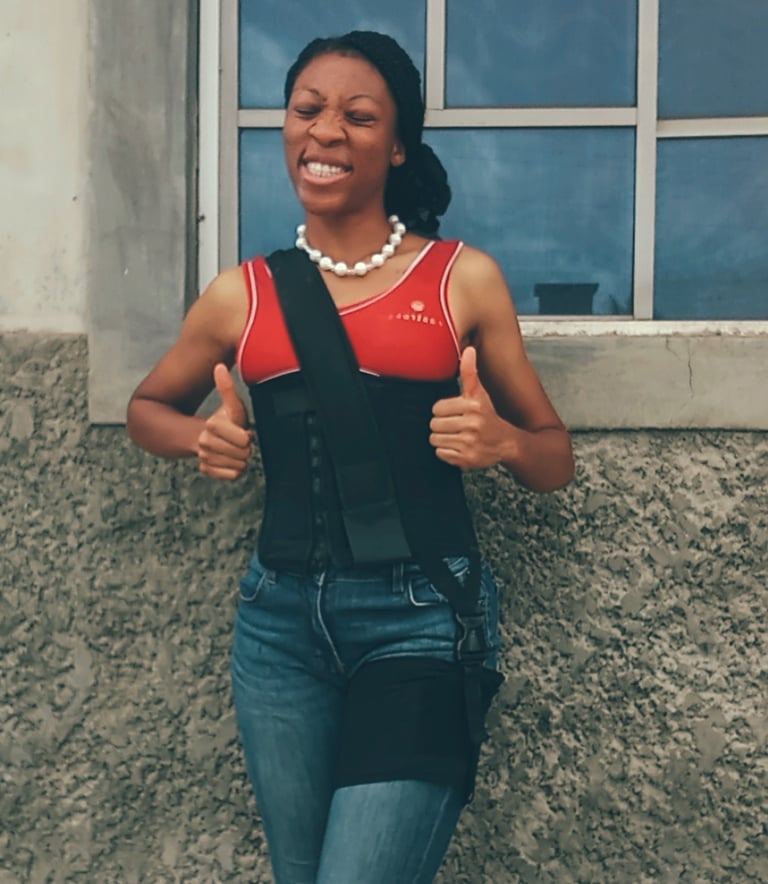
Within two weeks, I received my first custom spinal brace. It was thick, structured, and wrapped tightly around my torso, extending down to my waist with a strap connected to one leg. It looked almost like a piece of clothing, but it was far from it. It was corrective, restrictive, and uncomfortable. Yet, strangely, I felt a sense of relief. Something was finally being done.
That feeling didn’t last long once I had to wear it to school.
What began as treatment quickly became a source of attention I did not ask for. The stares, the whispers, the jokes; they came from everywhere. Classmates, seniors, juniors, even teachers. Some mocked openly, asking why I had “slippers on my back.” Others created rumors, speculating about my body in ways that made me deeply uncomfortable. Instead of support, I was met with curiosity that felt invasive and judgment that felt heavy. That was when I began to lose myself.
I stopped seeing who I was and started seeing only what others pointed out. My confidence disappeared, replaced by an identity crisis I did not know how to name. I kept everything to myself. I did not want more attention, more questions, or pity. So I stayed quiet. At night, when the world was asleep, I allowed myself to feel. I cried silently, holding in pain that was not just physical but deeply emotional.
I became hyper-aware of my body, the way I walked, sat, dressed. Everything felt like it was under scrutiny. I hid behind oversized clothes and jackets, trying to conceal the curve in my spine. Going out became exhausting; being seen felt like exposure. I withdrew, choosing solitude over interaction because it felt safer.
Even though I looked fine on the outside, I was falling apart within. My academics suffered. My energy drained. I moved through life mechanically, just trying to get through each day. I no longer recognized myself.
After three years of wearing the custom brace, it wore out. The physiotherapist said I could no longer continue with it, and for a moment, I felt relief. But that relief didn’t last. He explained that my spine needed another adjustment, the previous treatment could no longer carry me forward. When he measured it, the curve was above 40 degrees. He recommended a new brace. It looked simpler, but it marked the beginning of another phase of adjustments. I had to start wearing a brace to school again. I thought I would finally be free from the stares and the mockery but I was not.
The turning point..
One weekend, after an especially difficult week, I lashed out at my younger brother. The moment it happened, I knew something was wrong. That wasn’t me. I retreated to the bathroom, locked the door, and cried until I felt empty. Through tears, I whispered to myself over and over again,“this is not me.”
Someone noticed. My elder brother saw the change in me and, without telling me, reached out to a teenage pastor. That conversation became a turning point. For the first time, I opened up fully. I cried, I spoke, I released what I had been carrying alone. I prayed—not just for healing, but for peace. Around that time, I came across a song that carried a message I needed: there is a God who will answer your prayers in time when you trust in Him. Something shifted in me. My prayers changed. My perspective changed. And the next day, I walked into school differently. Not because people had changed but because I had. The stares did not stop, but they no longer defined me gradually.
Finding community
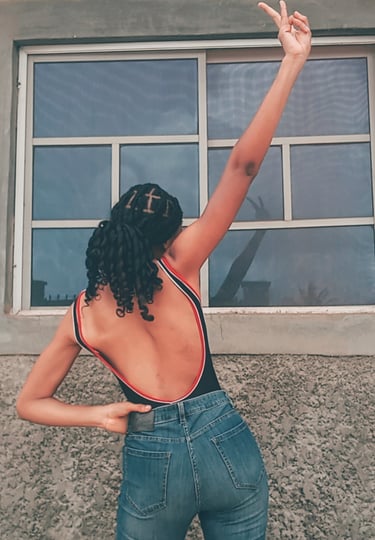
Not long after, I met Oluwatosin who understood my journey in a way few people could. She also lived with scoliosis, and through her, I found BACS community (Beyond a Curved Spine). For the first time, I did not feel alone. I felt seen, understood, and supported. Gradually, something beautiful began to unfold. People started to describe me as confident. They said I didn’t “look like what I was going through.” I would smile when I heard that, knowing how much it had taken to become that version of myself. For a long time, I believed I needed to hide. But one moment changed that belief. I was invited to a dinner, and instead of choosing something to conceal my body, I chose a gown that embraced it. I was nervous, but I made a decision to show up as I was. That night, something unexpected happened. People did not notice my curves. They saw me. They saw beauty, elegance, confidence. Compliments flowed freely. I felt visible in the best way, not because I was hiding, but because I wasn’t. That was when I understood: my beauty had never left. It had only been waiting for me to accept it.
As life moved forward, I encountered people who saw me beyond my curves. Friendships formed, conversations healed parts of me I did not know were still hurting. I began to understand that my worth was never tied to the shape of my spine. There are still moments when people use hurtful words. Names that try to reduce me to something smaller than I am. But I have learned to ask myself simple questions: Is that my name? Is that who I am? And the answer is always the same; No.
Scoliosis has been one of the hardest parts of my journey, but also one of the most transformative. It challenged me, stretched me, and forced me to confront parts of myself I might have ignored. It did not just shape my body, it shaped my mind, my faith, and my resilience. For a long time, I thought it defined me. But I’ve learned that it is only one chapter, not the entire story. I have dreams, passions, purpose. I have a voice. And I have chosen to use it. This is my story; one of pain, growth, faith, and becoming. And if there is anything it has taught me, it is this: you are more than what has happened to you. You are more than the labels, the stares, or the weight you carry.
Your scars do not diminish you. They remind you that you have endured. We all carry something, even if it isn’t visible. And even when life bends you, it doesn’t have to break you. There is still light in you. There is still strength in you.
You don’t have to be perfect to inspire. You just have to be honest. You just have to be real. You just have to keep going.
Reach out to Feyikemi